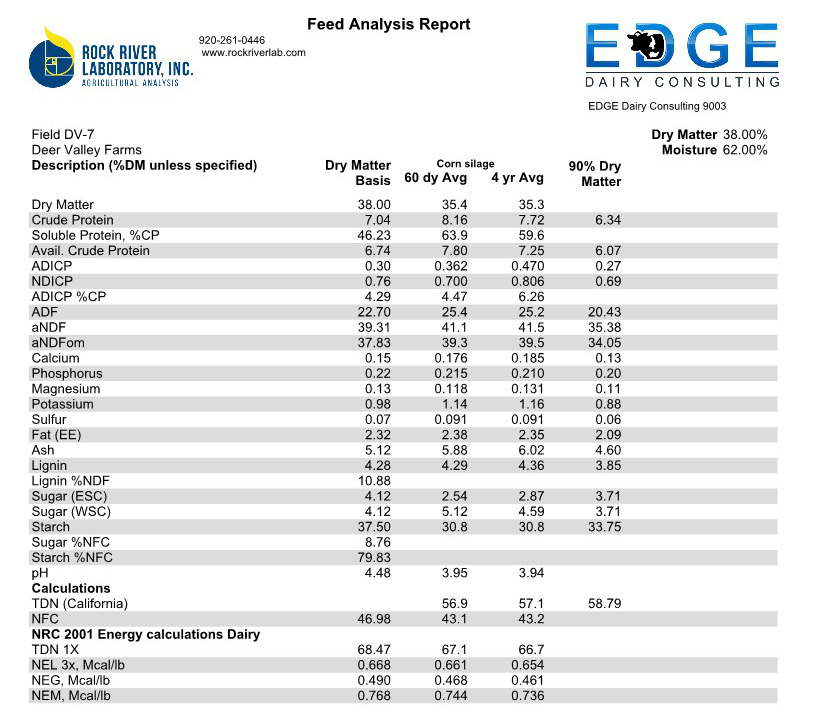
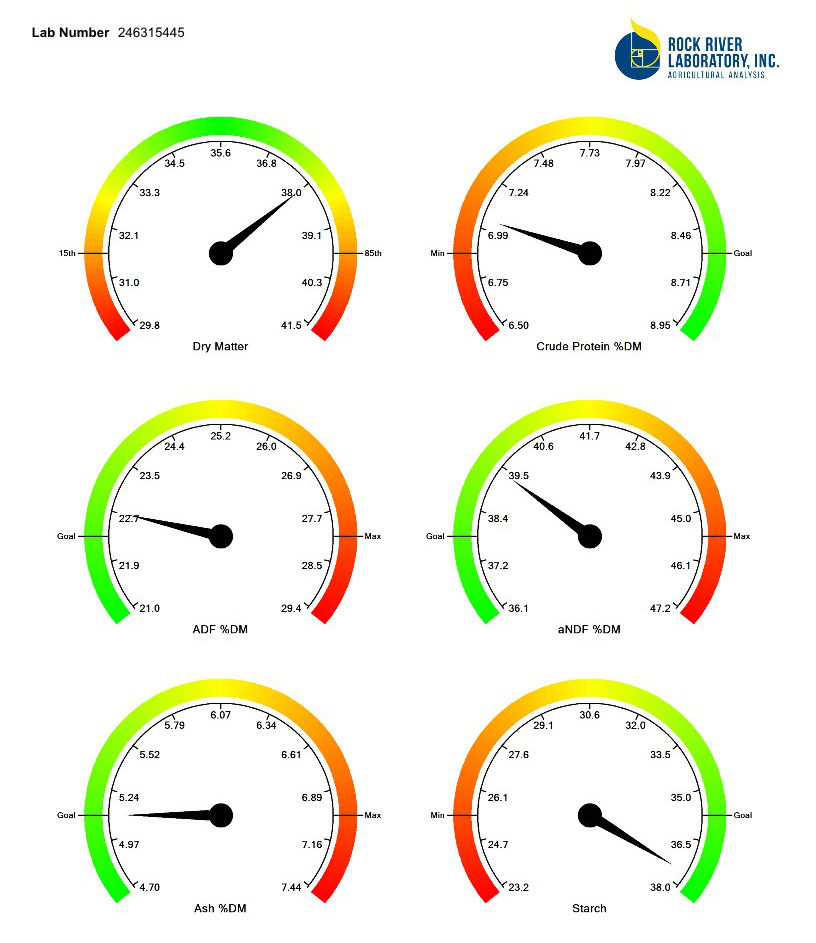
Understanding feed quality is critical for every farmer who wants healthy livestock and efficient production. Learning how to read feed report results can help you spot nutritional strengths and weaknesses quickly. For example, this report shows a Dry Matter of 37.9%. Ideally, corn silage should stay between 32–38%. Too much moisture can cause spoilage, while too little reduces digestibility.
Other critical measurements in Feed Report:
- Crude Protein (CP): This sample tested at 8.2%. Good silage typically ranges from 7–9%, so this is acceptable. Protein drives milk production, making it one of the most important markers.
- Neutral Detergent Fiber (aNDF): The report shows 41.0%. Values between 38–42% support rumen function. Higher fiber reduces energy availability, while lower fiber can cause digestive upsets.
- Starch: Measured at 34.0%. The ideal range is 30–35%, providing balanced energy without risking acidosis.
- Lignin: At 4.5%, this falls within the normal 3–5% range. Higher lignin means reduced digestibility.
- pH: Reported at 4.6. Good corn silage should remain between 3.8–4.2. Higher pH signals weaker fermentation and potential spoilage risk.
By checking these numbers, farmers can make small ration adjustments that lead to big results. For example, if starch is low, adding grain may improve energy intake.
How AgNote Helps Farmers Manage Feed and Crops
Feed reports are only one piece of farm management. With AgNote farm management software, permanent crop growers can go further. AgNote includes:
- A dedicated permanent crop management section
- Irrigation management tools
- Note-taking and task recording
- Season planning and food safety tracking
- Customizable Harvest Methods (can configure to adjust your yields to your target moisture percentage)
Farmers can also store feed reports by planting, making future comparisons simple. Plus, AgNote lets you create custom harvest methods and set the exact moisture percentage for yield adjustments.
